
WHOIS History as Evidence: Incident Response Use Cases and Chain of Custody Tips

By Qasim
Posted on January 12, 2026 | 10 min read
By Qasim
Posted on January 12, 2026 | 10 min read
WHOIS information resembles the domain name directory, with all the differences being who registered a site, when it was registered and who was the registrar. Such information can be stored in the public WHOIS databases and expert systems such as WhoisFreaks archive the records with time. Domain names play a crucial role in cybercrime investigation and digital forensics, as analyzing their WHOIS history can uncover malicious activity and ownership changes. A Historical WHOIS query can provide the whole history of a domain: its creation and expiry dates, previous registrant names and name-server transitions.
One of the first sources of any domain investigation is usually WHOIS. An analysis of WhoisFreaks points out that most internet frauds and scams are conducted using domains registered and even changed by threat actors, indicating that the attacker often forces new domains to carry out phishing and then changes or disregards them. By retrieving the historical WHOIS information about a suspicious domain, detectives will be able to retrace every action made by the adversary, although the domain might have later moved to a privacy service or moved to different ownership. Since WHOIS is an open source, it is regarded as good evidence, yet the most important thing is to write how it has been received and maintained.
Domain ownership is a cornerstone of digital investigations, offering crucial insights into who controls a website and their potential intentions. By examining historical WHOIS data, investigators can verify a domain’s registration history, track ownership changes, and detect signs of malicious activities. WHOIS records typically include important information such as the registration date, registration details, and contact information for the registrant, providing a detailed snapshot of a domain’s background.
However, privacy laws and data redaction practices can sometimes obscure these details, making it challenging to access the full picture of domain ownership. In such cases, specialized tools and techniques become essential for uncovering the necessary data. Historical WHOIS data can help bridge these gaps by revealing previous ownership information and registration changes that may no longer be visible in current WHOIS records.
For digital investigations, understanding domain ownership is key to identifying patterns of abuse, linking domains to specific individuals or organizations, and verifying the legitimacy of a website. By analyzing domain registration history and ownership changes, investigators can uncover connections between domains, spot potential red flags, and gather important information to support legal or regulatory actions. Ultimately, the ability to access and interpret WHOIS data empowers organizations to verify domain ownership, detect malicious activities, and respond effectively to emerging threats.
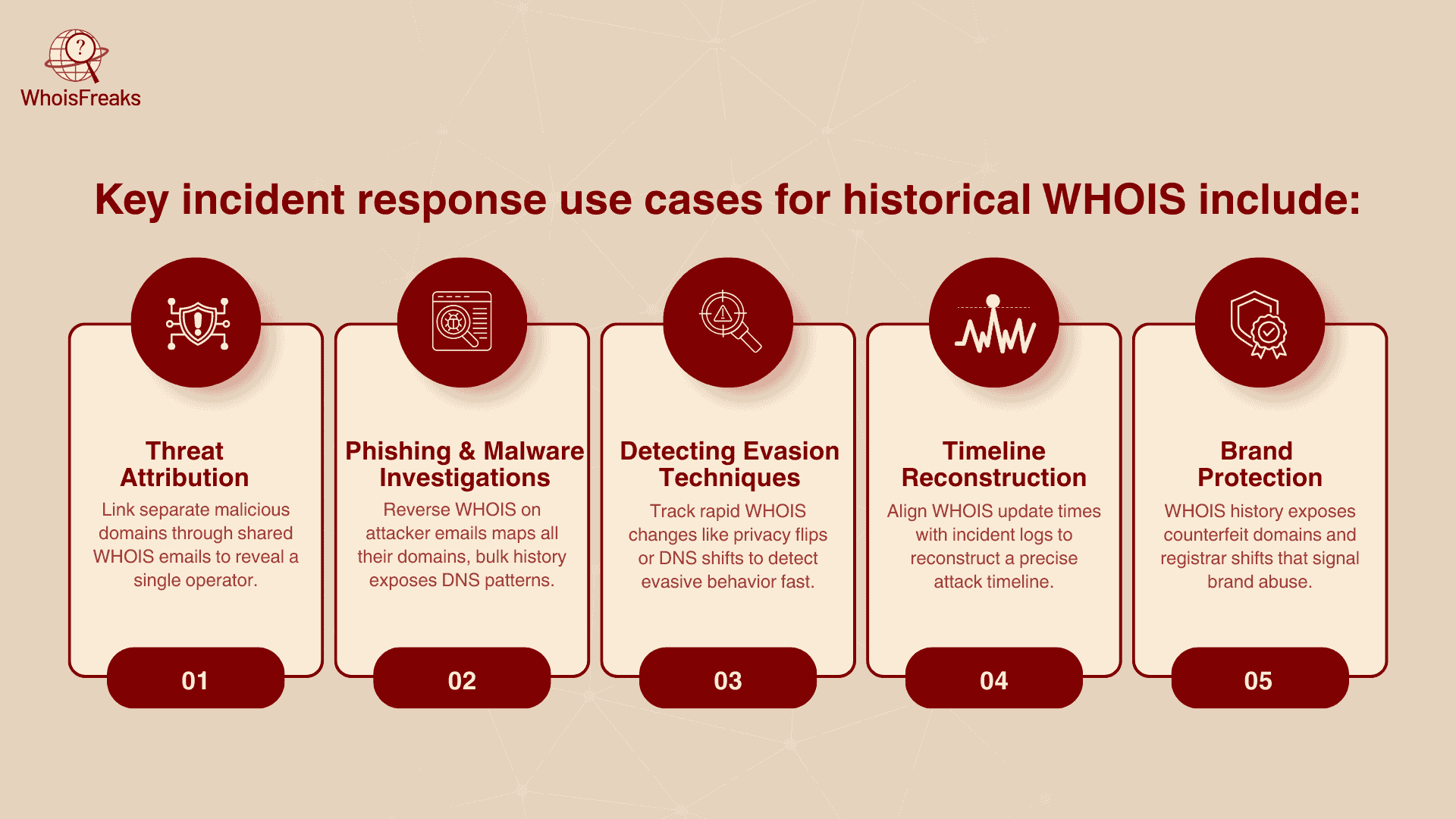
Incident response has numerous uses of historical WHOIS data. It assists the investigators to assign attacks by correlating domains with the threat actors. An example is when two or more malicious domains had identical registrant email addresses or organization names, WHOIS history would show that identical identifiers linked those domains to the same assailant. Cybercriminals often operate various domains with similar registration details, which helps in tracing and analyzing cyberattacks. Another suspicious transfer that is monitored by the analysts is an abrupt change of the domain registrant or registrar: the attacker may have sold the domain to another organization to avoid being tracked. The history of WHOIS will then record the time that transfer occurred and the new registrant.
Historical WHOIS is also useful for threat hunting and proactive defense. If a new attack is detected, analysts might search a known malicious email or name in the Reverse WHOIS tool to uncover the attacker’s entire domain portfolio. Likewise, organizations often use Domain Monitoring to watch their own brand names and related domains. For example, a security team might add all spellings of yourcompany to a monitoring list. If an attacker registers screenshotapi-security[.]com, the monitoring service immediately alerts them, revealing the WHOIS details so they can act quickly. In this way, WHOIS history and monitoring become part of an organization’s "cybersecurity radar."
The Kelihos botnet was a network of criminal, globally located systems that have been utilized in many years to send voluminous spam as well as distribute malware and collect credentials and money laundering schemes. The law enforcement and security researchers in the United States collaborated to challenge and disrupt it and eventually arrested one of the key operators.
Kelihos was not a single server, but rather a peer-to-peer (p2p) botnet with tens of thousands of infected computers and dozens of command-and-control (C2) nodes all over the world. The domain intelligence and WHOIS records among other data sources (network traffic, email analysis etc.) allowed the investigators to determine the most important elements of the botnet infrastructure and associate them with the criminal actors.
Although the police do not often release comprehensive technical specifications of all their investigation methods, as evidenced by publicly accessible court records and cybersecurity audits, domain data, IP addresses and registration information are being used by the analysis to:
This form of evidence gathering is accurate since the history of registration of domains (via WHOIS) can reveal the way malicious infrastructure is established and evolves with time. E.g. Correlating frequent registration emails, or similar names of registrants across multiple domains can assist the investigator to draw a full picture of how the infrastructure of an attacker changed, and how various infrastructure items are connected to the same criminal activity.
Combining WHOIS history with network intelligence and legal authority, law enforcement succeeded in:
The Kelihos case highlights how historical domain data and evidence tracing are essential tools in modern cybercrime investigations. WHOIS history forms part of the cyber trail that connects malicious domains to threat actors even when attackers attempt to hide behind proxies or rapidly change infrastructure.
WhoisFreaks provides a suite of tools to automate each step of WHOIS-based investigation:
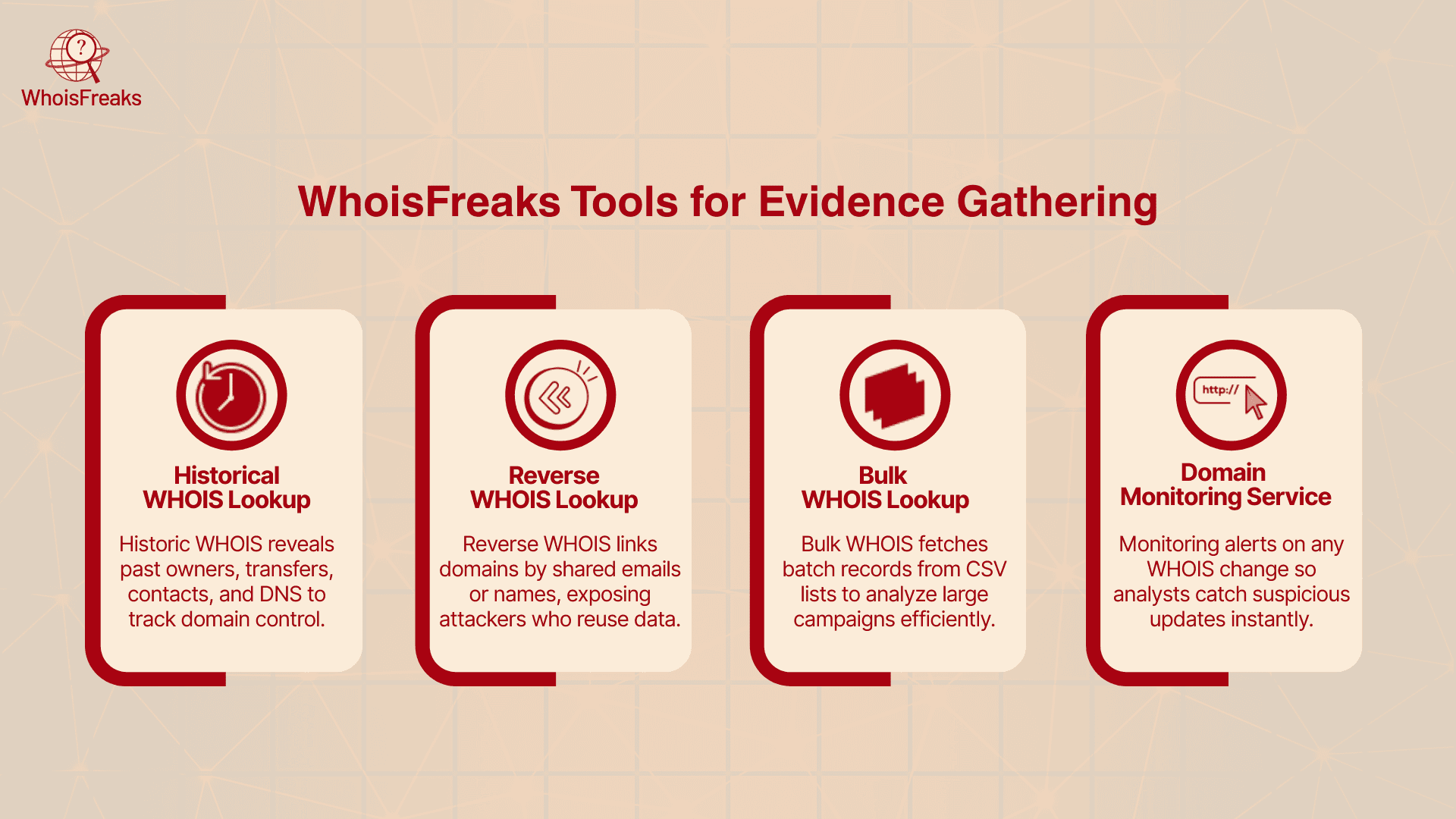
These tools can be integrated into existing systems and applications via API calls. The WHOIS history database is continuously updated with the latest registration occurrences, ensuring analysts have access to the most current data. WHOIS history tools can also help in market research by providing information about domain names related to competitors and customers.
Chain of custody is used in forensic studies, and it is the record of the way evidence was used, by whom, when, and where it was passed on or analyzed. In the case of digital evidence such as WHOIS data it would imply that there is a clear audit trail between the time data is gathered and when it is presented. To make sure that the WHOIS findings are accurate and admissible, the following best practices should be followed:
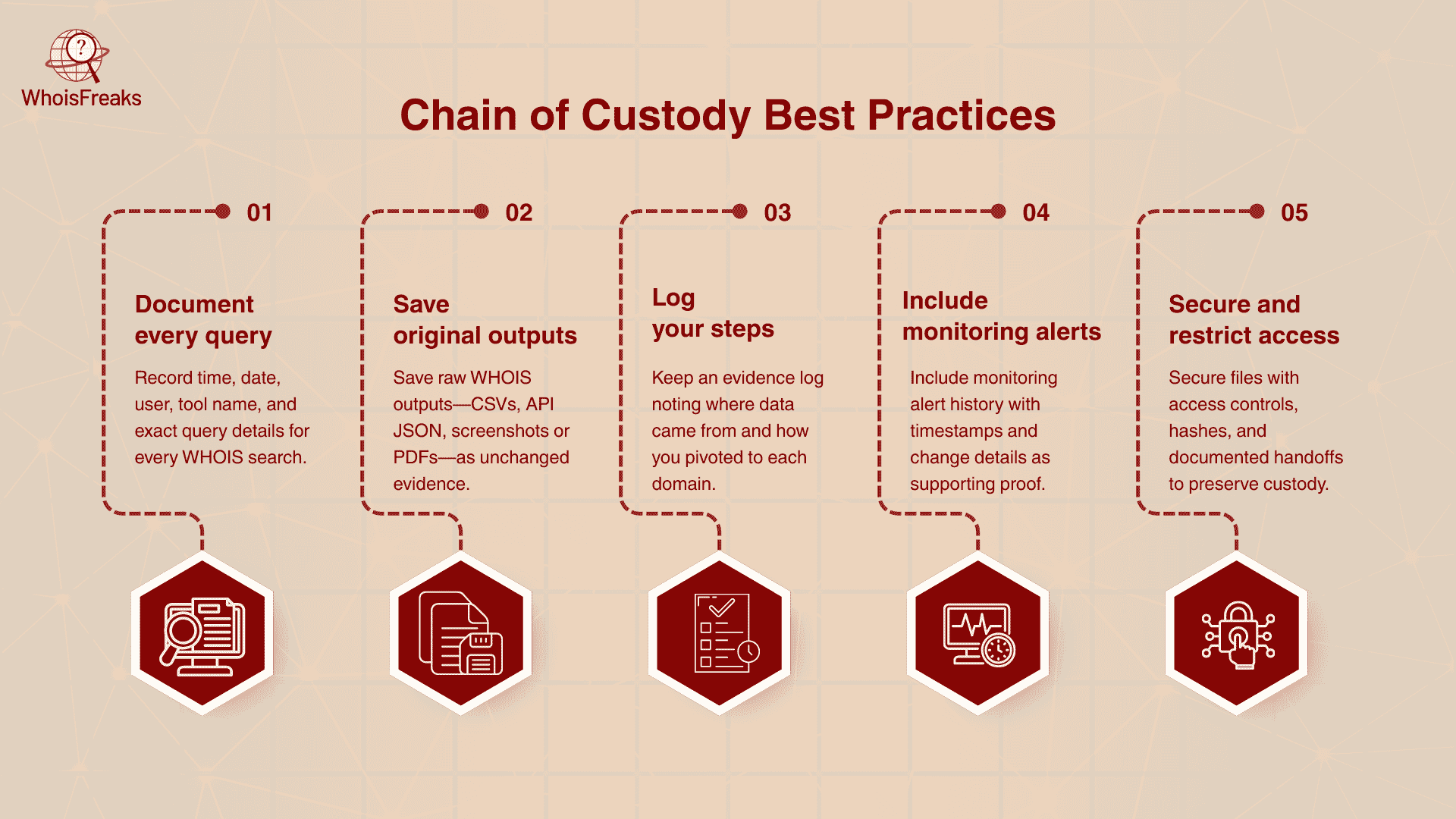
The steps above will make sure the evidence of the WHOIS is reliable. An audit trail will record every single step of the data collection process, through to analysis, which can be shown to illustrate how that specific piece of data was acquired.
Historical WHOIS data is not merely the information it is the digital fingerprint of the domain activity. Using such tools as the Historical WHOIS, Reverse WHOIS, Bulk Lookup, and Domain Monitoring of WhoisFreaks, cybersecurity teams can:
This data is credible, dependable and legally justifiable, as proper documentation and chain of custody practices are observed. Through incorporating the WhoisFreaks into your incident response process, you have a clear-cut edge of detecting threats ahead of time and responding promptly.
Call to Action: Start protecting your organization today. Visit WhoisFreaks.com and explore their Historical WHOIS and Domain Monitoring tools to uncover hidden threats, track malicious domains, and strengthen your cybersecurity defenses. Every suspicious domain tells a story make sure you can read it before it’s too late.
WhoisFreaks offers daily & historical domain data with WHOIS/DNS insights for threat analysis.
9 min read
Explore how WHOIS history aids forensic analysis in cybercrime investigations. Learn effective strategies to enhance your cyber defense. Read more now!
9 min read